70

Walk Score Policy — JPods & the 5X5 Free Market

Fiscal future
70 WalkScore
predicts your city's

Per Acre infrastructure costs and income from sales and property tax have a tipping point at ~70; acres below 70 bleed resources; acres above 70 pay the bills.

Cities have a split-personality: old walkable, safe for children, >70; new is car-centric, dangerous for children, <70.

Before 1944 all American cities were walkable. Planning decisions were local, Bottom-Up. Post World War II, decisions shifted to Federal Top-Down planning exemplified by Federal-Aid Highway Acts of 1944 and 1956. In 1960, President Eisenhower realized the mistake. Instead of increasing national security, the Interstate Highways resulted foreign oil addiction and funded enemies oil-dollars. Beginning with Nixon, every US President identified that foreign oil addiction builds a path to war. Oil-was have been nearly perpetual since 1990: Iraq, Afghanistan, Venezuela, Iran.

No Cost Action: 5x5 FreeMarket restored liberty for Bottom-Up innovation to convert traffic costs into value.

Sources: US DOT National Household Travel Survey 1969–2009  |  CDC/NHANES 1971–2018  |  Walk Score®  |  Urban3 / Strong Towns

Scroll

WalkScore.com — look up your city right now

Below 70, your city loses money. Above 70, your city makes money.

Walk Score and Fiscal Productivity of StrongTown and UrbanThree provide metrics of whether a neighborhood generates more tax value than it costs to maintain its infrastructure. Walk Score of 70 functions as a break-even line for municipal budgeting.

Walk Score
Below 70
Net fiscal drain
Not fun to walk. Single-use zones. No destinations within walking distance. No street life. Requires a car for every errand. Tax productivity far below infrastructure cost. Your city loses approximately $6,000 per acre per year more than it generates in taxes.
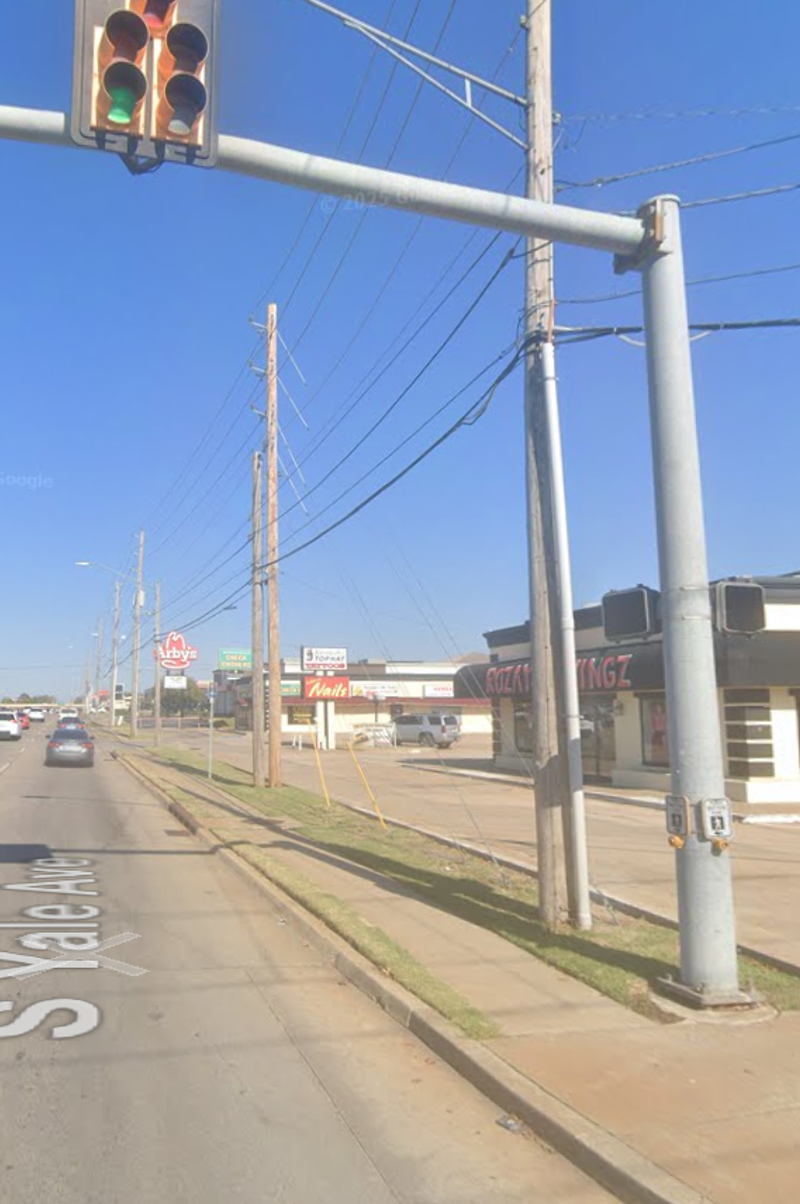
The stroad. The strip mall. The parking lot. The big-box bypass. The subdivision cul-de-sac. The six-lane arterial that killed the businesses on both sides.
70
Walk Score
70+
Fiscally self-sustaining
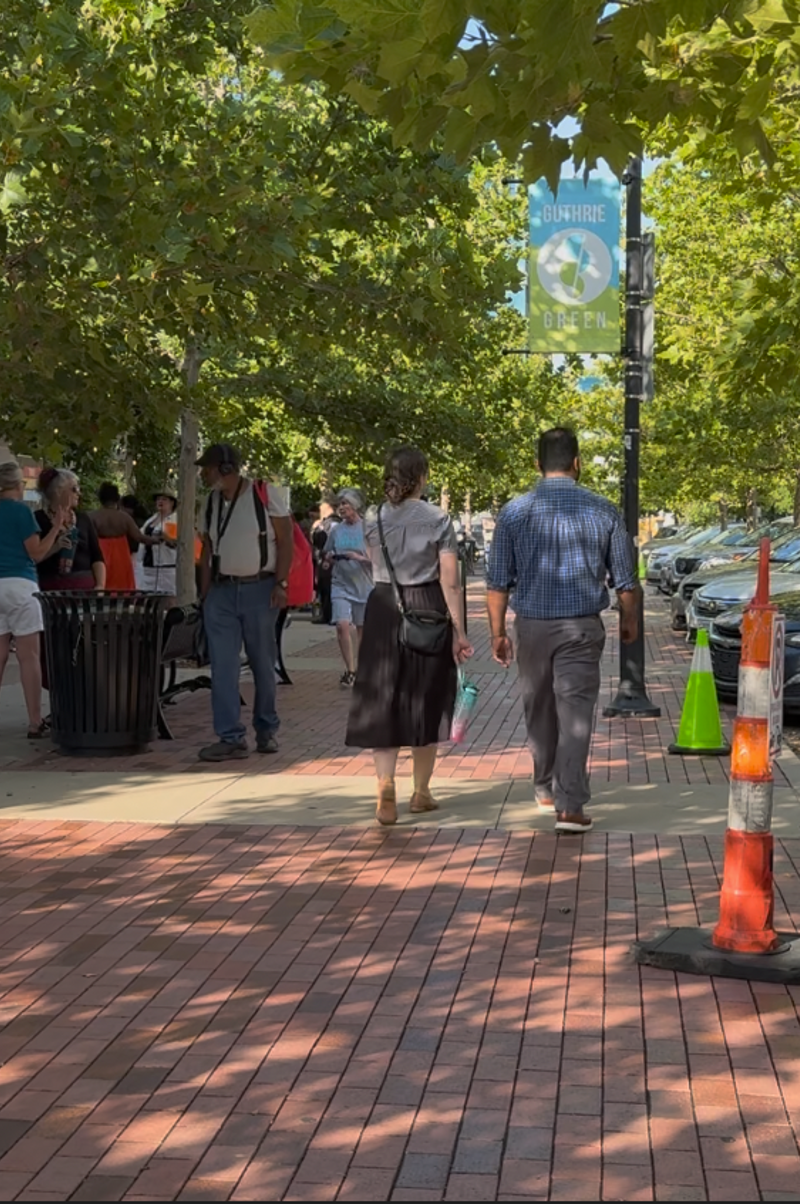
Street life. Eyes on the street. Fun for walking and people watching. Mixed uses. Destinations within walking distance. Tax productivity of $90,000+ per acre per year. Pays for its own streets, pipes, parks, and services. Generates surplus revenue for the city.
Your downtown. Your historic district. The street you take visitors to. The neighborhood farmers market. The block your city gets photographed on.
The fiscal case — Urban3 & Strong Towns data

Same city. Same tax rate.
Radically different returns.

Urban3's per-acre tax productivity analysis of dozens of US cities finds the same pattern every time. The old walkable core — often neglected and underinvested — generates far more tax revenue per acre than the subsidized sprawl surrounding it.

Walk Score Below 70 — Car-Centric
−$6K
Net fiscal drain per acre per year
  • Costs more in infrastructure than it generates in taxes
  • Requires 2 cars per family — both depreciating assets
  • 85% of car costs drain out of the local economy
  • Requires more road miles per resident served
  • Big-box generates $0.6M/acre vs. walkable downtown $1.1M/acre
  • Creates long-term maintenance debt that compounds every year
Walk Score 70+ — Walkable
+$90K
Tax surplus per acre per year
  • Pays for its own infrastructure maintenance
  • Generates surplus revenue for city services
  • Supports local businesses that keep money in the local economy
  • Arlington, VA: 10% of land → 50%+ of tax revenues
  • Requires less road infrastructure per resident served
  • Enjoyable
Car-centric land — per acre per year
−$6,000
Net negative to city budget. Costs more in road maintenance, utilities, and services than it generates in sales and property taxes.
Strong Towns — Brainerd, MN analysis / confirmed across dozens of US cities
Walkable commercial — per acre per year
+$90,000
Net positive to city budget. Pays its own way and generates surplus for services elsewhere.
Urban3 / Strong Towns fiscal productivity analysis

The Walk Score Policy Test

Actions based on 70.

Every policy decision that lowers Walk Score below 70 triggers a spiral of ever lower Walk Score for that part of your city with ever larger fiscal deficits. Every policy that raises Walk Score above 70 generates fiscal surplus and improves children's safety. Resources are 8-80, StrongTowns, Urban3, CNU, Shoup, Jacobs, and a growing list of other.

The policy test

"Will this raise or lower the Walk Score
of this neighborhood?"

Apply this test to every rezoning, every road widening, every parking minimum, every highway expansion, every transit decision. The Walk Score answer predicts the fiscal outcome with high reliability.

✗ Lowers Walk Score below 70
City loses approximately $6,000 per acre per year on this land — permanently. Children cannot safely walk or bike. Residents require two cars. 85% of spending leaves the local economy. Maintenance debt compounds every year.
✓ Raises Walk Score above 70
City generates surplus tax revenue from this land. Infrastructure pays for itself. Streets become safer for children. Local businesses return. Residents spend less on transportation. Money stays in the local economy.

"Use the US Constitution to
block highway expansion?"

Communications precedent, the Internet:

  • Courts declaring the federal communications monopoly unconstitutional in 1982 surprised most Americans.
  • The Internet replacing rotary telephones and the analog network surprised most people again. Yet the technology had existed for decades. The first video call was in 1927. Hedy Lamarr patented the technology of WiFi and BlueTooth in 1942.

Transportation future Physical Internet®:

  • Federal highways are unconstitutional.
  • 21 Presidential veto messages explaining the "post Roads" restriction.
  • 10 Presidents stating the risk of oil wars (Iraq, Afghanistan, Venezuela, Iran) mandated for federal highways.
  • The technology to solve urban traffic and end oil wars has been well understood for decades (Wuppertal and Morgantown PRT, Congressional study, New Jersey Legislature study).
  • Federal violation of the Constitution began with The Federal-Aid Highway Act of 1916 and expanded in 1944, and 1956.
  • Top-Down federal planning has decimated urban fiscal solvency. Only 1.2% of urban land remains walkable despite producing 20% of GDP (World Economic Forum)
  • America is a compound republic with Divided Sovereignty. States, counties, and cities are sovereign over highways and other "internal improvements (link)"

Paths to war and Climate Change
The Boston Tea Party was a demonstration against the general government's mercantile transport monopoly that triggered a war. To keep from rebuilding that path to war, the Framers voted 8 states to 3 to forbid federal highways on Sept 14, 1787. This Divided Sovereignty of the Constitution is explained in 21 Presidential veto messages.
✓ Oil wars in Iraq, Afghanistan, Iran

President Nixon: “At the end of this decade, in the year 1980, the United States will not be dependent on any other country for the energy we need. We will hold our future in our hands alone.”

Quotes by US Presidents on why federal highways are unconstitutional and how foreign oil addiction builds a path to war of Iraq, Afghanistan, Venezuela, and Iran.

The 5X5 Free Market solution

JPods Networks increase Walk Score.
Privately funded. No tax dollars.

JPods is middle-mile infrastructure — connecting walkable nodes to walkable nodes, the same role the streetcar played before 1956. By removing 60% of car trips from local streets, JPods makes those streets safe to walk and bike. Walk Score rises. Fiscal drain converts to surplus.

Step 01
Policy: More of what works
City governments apply their existing Rights of Way contracts for communication and energy networks to transit networks to establish 5x5 Free Market. Privately funded networks 5 times more efficient than roads paying 5% of revenues for non-exclusive use of the airspace over approved public Rights of Way.
→ Net positive to city from day one
Step 02
Fewer cars, less traffic
JPods are grade-separated -- no traffic. A mesh networks within walking distrance of your house and work. Solar collectors over the guideways gather the energy to power the networks. No oil supply shocks. JPods provide the on-demand service of personal cars without the car payments, parking problems, and with 10x lower costs
→ Walkscore increases.
Step 03
Safer streets
Fewer cars means safer streets. Children can walk and bike to school again. The 13% becomes 48% again. A determined effort in Palo Alto, CA increased street safety, 13% increased to 60% of students riding bikes to school.
→ Physical activity returns to daily life by design. The 1 in 5 childhood obesity rate begins reversing.
Step 04
Proximity
Neighborhood commerce returns as JPods networks deliver pallet-size cargo as efficiently as big box store receive containers. With cost parity, the corner grocery store becomes viable again. One car per family becomes sufficient again — as it was before 1956; saving families a car payment per month.
→ Families save by shifting from 2 to 1 car.
Step 05
Fiscal drain decreases
The car-centric $6,000/acre/year drain on resources deminishes as real estate is converted to housing, retail, and manufacturing. The city's fiscal position improves permanently — without raising taxes. The city also profits as JPods pays the city 5% of gross revenues for Rights of Way.
→ City budget improves
Step 06
Bottom-Up Restored
The federal, car-centric, Top-Down central planning since the end of World War II is replaced by locally controlled Bottom-Up regulations.
→ City become more livable at lower costs.
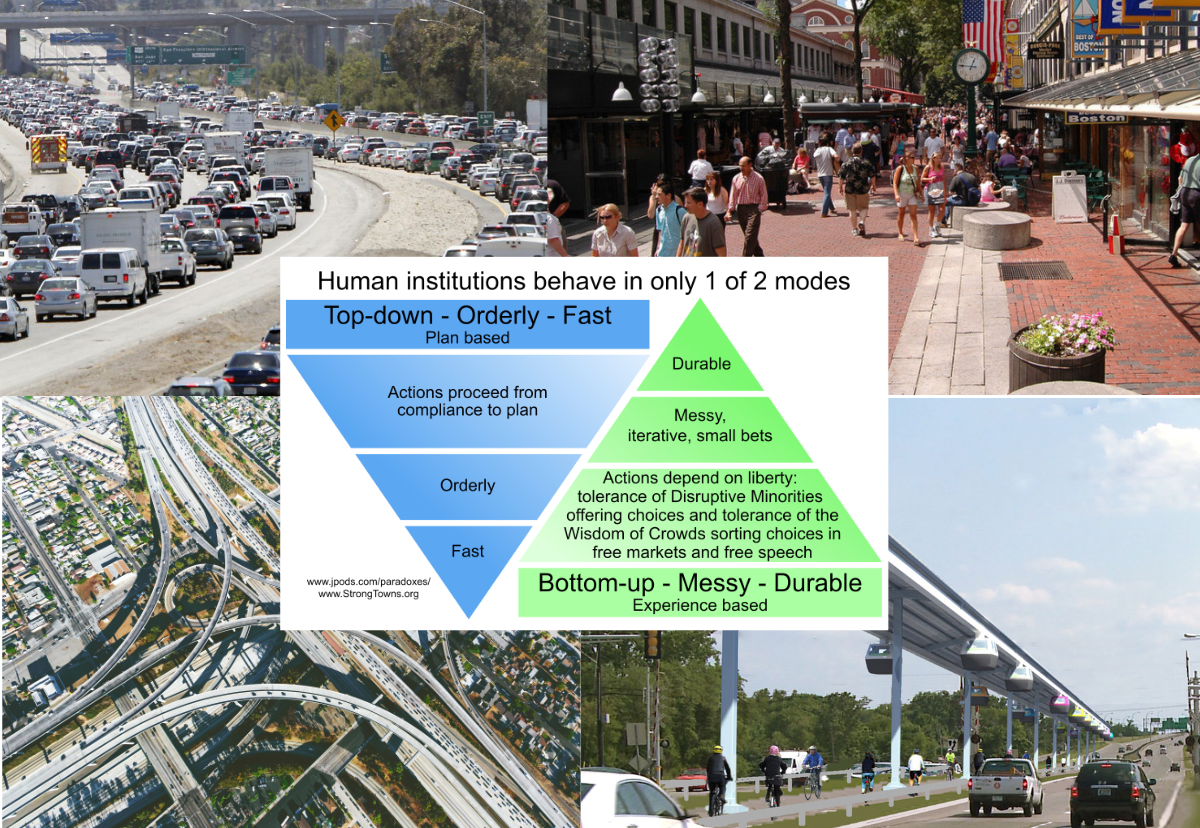
Top-Down vs Bottom-Up: Highway vs Walkable Community

The Walk Score trajectory with JPods

Pre-1956
70+
Walkable by necessity. Children walk to school. One car sufficient.
Today
~44
Car-Dependent. National urban average. 13% walk to school.
With JPods
60%↓
Car trips reduced 60%. Streets become safe. Foot traffic returns.
Restored
70+
Walkable. Self-sustaining. Children healthy. City fiscally positive.

The 5X5 Free Market — six pillars, all pre-existing

Your city adopting
5x5 Free Market
restores liberty to innovate.

Use existing Rights of Way city contracts.
No tax dollars. No federal bureaucratic delays.
Private funding. 5% of revenues to your city.
The same franchise contract you use for cell towers.
Your state constitution already supports it.
The stroad becomes a street again.
Children walk to school again.