
Using the Bolden Street development in Greenville, SC as an example, following is an executive summary, followed by the ai prompt that returned it. Link to a Google Doc containing detailed responses from multiple AIs. Try the prompt for your real estate projects.
Executive Summary
The Bolden Street District in Greenville, SC, is a 90-acre mixed-use redevelopment project currently planning for 2,900 residences, 500,000 sq. ft. of office space, and 750,000 sq. ft. of retail. By implementing a transit network (such as the proposed JPods) and prioritizing pedestrian infrastructure the project could unlock significant value.

This shift mirrors the successful urban pivots seen in downtown Greenville, Europe post-1973 and Paris (2007–2024), as well as modern US developments like Culdesac Tempe. The result would be the reclamation of approximately 20–40 acres of land, a construction cost savings of $84M–$140M, and a dramatic improvement in public safety and family disposable income.
Prompt Begin (copy all between begin and end)
I would like a 1-2 page summary of the economic benefits and land-use conversion from parking to commercial/residential use from a 60% reduction in car-requirements relative to the Bolden Stree project in Greenville, SC.

Please look at the data points referenced below and provide an assessment and/or estimate:

Land use:
Planned land-use to meet parking space requirements versus 60% reduction in those requirements. How much land is converted from parking to commercial/residential/greenspace?
What are the cost savings?
What are the future sales tax and property tax benefits to the city and county.
Safety:
What is the current state of pedestrian safety in Greenville.
What is an estimate of injuries and deaths reductions from a 60% reduction in car-miles.
Debt reduction and income improvement
What is the expected increase in family disposable income if car-ownership is reduced 60%?
What are the expected yearly cost savings for a family if car requirements are reduced by 60%.
Is a 60% reduction in car-use a reasonable estimate based on car-ownership per family in the US before 1956 and the reduction in car-miles in Europe after 1973.

Can you access the Bolden Street District project in Greenville, SC. https://boldenstreetdistrict.com/

Can you access Culdesac Tempe?
https://culdesac.com/tempe/?

Can you access JPods planned network for Greenville and the Bolden Street area?
https://jpodssc.com/greenville/

Can you access data showing that in 1973 the US and Europe had the same car-centric policies, used about the same oil per person per year of 43 MWh, and had about the same pedestrian road crashes. Following the 1973 Oil Embargo and the “Stop de Kindermoord” in the Netherlands, Europe shifted back towards walkable cities reducting per person oil use to 60% below the US and roadkill of pedestrians to 400% below the US.
https://usa.streetsblog.org/2020/10/10/exactly-how-far-u-s-street-safety-has-fallen-behind-europe-in-four-bombshell-charts

Can you access how Paris has become much more walkable between 2007 and 2024?
Prompt End
Additional Information for Real Estate Efforts
Below is a prompt for real estate developers and city officals to use to assess the benefit from shifting from car-centric to walkable cities. Link to assessments for various cities.
American cities used to be walkable. Every city over 10,000 people had one or more privately funded streetcar networks in the early 1900s. This prompt will hopefully provide financial justification for returning to an economy where people were not forced to buy cars by government central planners. If you are interested, following the prompt is a summary of the unconstitutional policy mistake that resulted in unwalkable cities.
The Morgantown PRT provides a 53-year case study in how we can apply grade-separated robot vehicles to make streets safe for children. JPods networks modernize and solar power the success of PRT, or podcar networks.
Real estate developments can be safer and more profitable by shifting from car-centric to walkable. JPods networks (90-second summary) and bicycles provide middle-mile and last-mile technologies:
- Proximity: JPods networks’ cargo capabilities increase proximity as small businesses have the lower delivery costs of containers being delivered to Big Box stores.
- Safety: JPods preempt risks of road crashes.
- Energy Security and Efficiency: Solar powered JPods remove risks of oil supply shocks.
- Land use: JPods preempts 60% of parking requirements. The land consumed by one car supports building 3 miles of JPods guideways with many vehicles.
- Linear barriers to commerce and community. JPods grade separation preempts 60% of linear barriers.
- Fiscal city health improves as 60% of car-centric infrastructure costs are preempted.
- Personal health, as walking increases to approach that of New York City or Paris.
- JPods networks provide the Middle Mile™, making cities walkable and bikeable. Links to 90-second summary, metrics, and example networks. Link to model networks in your city.
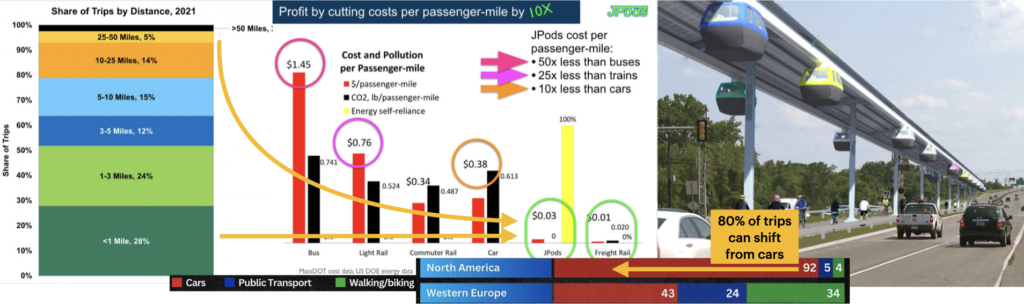
Proximity, walking, biking, and JPods can convert 60% of car trips
- In 2021, 92% of U.S. daily trips are less than 25 miles, the middle-mile solution provided by JPods networks.
- 52% of U.S. daily trips were under 3 miles, and 28% were under 1 mile, confirming that the vast majority are within practical walking/biking or low‑speed‑vehicle distance.
- Yet almost all trips are by car. Across U.S. and Canadian cities, about 92% of commutes are by car, only 4.6% by public transport, and 3.5% by walking or cycling.
- Cars are expensive and sit idle. Recent estimates put average U.S. car ownership cost at about $12,182 per year, up from $10,728 the year before. Travel‑survey and utilization studies indicate that private cars are typically in motion only 4–5% of the time and parked about 95% of the time, meaning a high‑capital asset is mostly idle.
- North American communities typically provide 3–8 parking spaces for every vehicle. Put together, a “free‑parked” car represents on the order of $17,000 per year in combined private and public costs per vehicle, even though that vehicle is in motion <5% of the time and parked about 95% of the time. ppl-ai-file-upload.s3.amazonaws+3
- Nationally, public K‑12 school systems now spend around $15,600 per pupil per year, with large states such as New York exceeding $29,000 per student and low‑spending states still near $10,000 per student. census+2
Copy and paste into ai to get an assessment for a real estate project
Only 1.2% of American cities are walkable today, yet they produce 20% of US GDP and are the only parts of cities where sales and property tax revenues exceed the cost to maintain the highway infrastructure (potholes).


History of our mistake
Odd as it may seem to us today, the Constitutional Convention voted 8 states to 3 to forbid the Federal highway system on Sept 14, 1787. The Boston Tea Party was a demonstration against the general government’s transportation monopoly that triggered a war. To prevent mixing commercial self-interests with war-powers the Constitution specifically forbid federal taxing to provide welfare, limiting it to only “promote the general welfare,” limiting it to build no roads beyond delivering letters to defend free speech, “post Road,” with “No Preference” in the facilities of commerce of one state over another.
Until 1916 there were 21 veto messages enforcing the “post Roads” and “No Preference” clauses of the Constitution. President Wilson socialized transportation with the Federal Aid Highway Act of 1916 and communications by Executive Order in July 1918. FDR socialized energy with the Rural Electrification Act of 1936.
Starting with President Nixon, every president has warned of the risks of oil war mandated by Federal highway oil addiction.
Oil wars have been perpetual since 1990.
It is the purpose of governments to minimize violence from war and crime by coercing compliance with law. Innovation is a compliance failure. So when governments control the means of production, the two aspects of liberty essential to innovating the general welfare are blocked. See Divided Sovereignty. Courts ending the Federal communicatons monopoly in 1982 restored liberty to innovate – rotary telephones and the analog network were replaced by cell phones and the Internet.
When liberty to innovate in transportation is restored, we will solve traffic with 10X lower costs than government mandated, highways that make unwalkable cities and energy moving 2-tons to move a person (link to short book).